THE LINUX FOUNDATION PROJECTS

Funding Opportunities

Explore current funding opportunities supporting open source wireless innovation across the OCUDU ecosystem. Check back regularly for new solicitations, programs, and opportunities to advance research, development, testing, and real-world deployment.

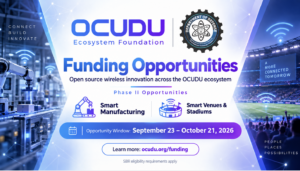
Phase II Opportunities: Smart Manufacturing and Smart Venues & Stadiums

Two Phase II opportunities are open for proposals focused on demonstrating open source private 5G platforms built with OCUDU and complementary open source technologies.

Opens: September 23, 2026
Closes: October 21, 2026

Smart Manufacturing

The objective of this Phase II effort is to design, validate, and demonstrate a fully open-source, private 5G network platform for smart manufacturing that integrates OCUDU, SD-Core, SD-RAN, and OSC components into a secure, vendor-neutral architecture.

Proposers must address at least two of the following four use cases in their Phase II Statement of Work and must identify which use case(s) their reference architecture and pilot deployment are designed to validate.

Smart Manufacturing Use Cases

  • Use Case 1: AGV/AMR Connectivity & Mobility
  • Use Case 2: Machine Vision Backhaul
  • Use Case 3: Connected-Worker Safety
  • Use Case 4: Secure Outdoor Yard & Logistics Coverage

Opportunity Window: September 23–October 21, 2026

Apply HereSee Key Performance Indicators

Smart Venues and Stadiums

The objective of this Phase II effort is to design, validate, and demonstrate a secure, high-density private 5G network platform for stadiums and large venues—integrating open-source OCUDU, SD-Core, SD-RAN, and OSC components—to deliver resilient, multi-service communication alongside a 6G-ready Integrated Sensing and Communication (ISAC) architecture.

This platform will be validated at a representative venue site to prove stable performance under extreme device congestion, enable native device localization for crowd analytics, and establish a cost-effective, vendor-neutral dual-use framework for both commercial entertainment venues and dense military installation environments.

Proposers must address at least two of the following four use cases in their Phase II Statement of Work and must identify which use case(s) their reference architecture and pilot deployment are designed to validate.

Smart Venues and Stadiums Use Cases

  • Use Case 1: High-Density Fan Connectivity & Broadcast/Production Backhaul
  • Use Case 2: ISAC-Enabled Crowd Analytics & Situational Awareness (6G-Ready)
  • Use Case 3: Public Safety & First Responder Priority Communications
  • Use Case 4: Venue Operations, Logistics & Outdoor Perimeter Coverage

Opportunity Window: September 23–October 21, 2026

Apply HereSee Key Performance Indicators

SBIR Eligibility

Applicants must meet SBIR eligibility requirements, including:

  • Be a for-profit entity located in the United States. Nonprofits are eligible only as research institution partners.
  • Have fewer than 500 employees. Most applicants have fewer than 10.
  • Be owned and controlled by U.S. citizens or permanent residents.

Additional restrictions may apply to companies with venture capital ownership. See the full eligibility guidelines for complete requirements.

All applicants to the SBIR or STTR programs must register on SBIR.gov. After registering, applicants must print the completed proof-of-registration form and provide it when responding to SBIR/STTR solicitations.

Registration information must be updated every six months to ensure accuracy.