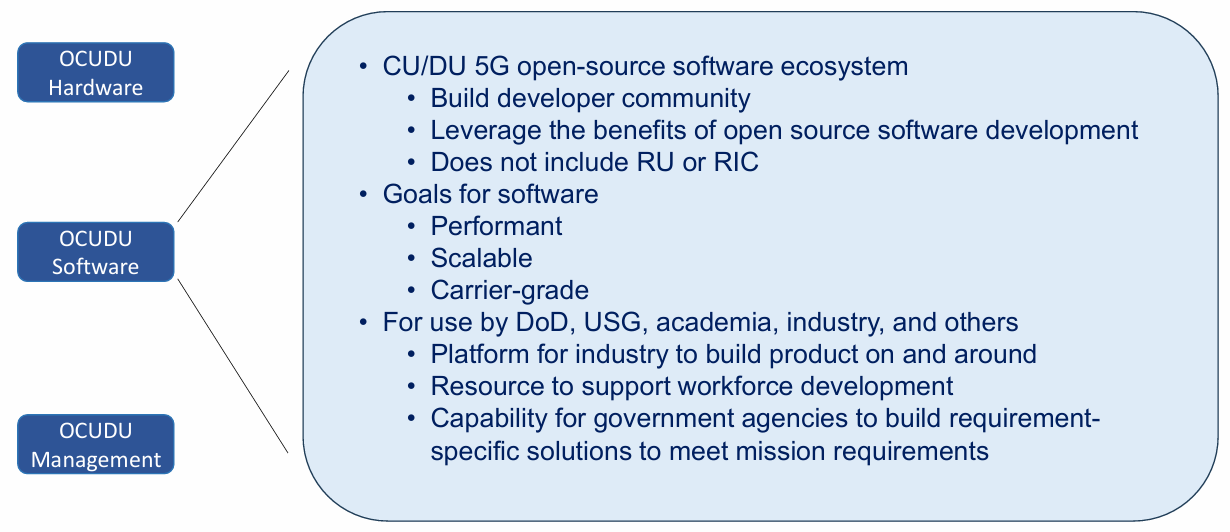

OCUDU implements the full open source RAN software stack and runs on general-purpose x86 and Arm hardware. Its standards-based, disaggregated architecture gives developers, operators, researchers, and technology providers an open platform for deploying networks, integrating third-party components, experimenting with new capabilities, and contributing innovations back to the community.
Key capabilities include
- Radio and physical layer: FDD and TDD; FR1 and FR2; bandwidths up to 100 MHz in FR1 and 400 MHz in FR2; 15, 30, and 120 kHz subcarrier spacing; and up to 4×4 MIMO
- Mobility and resiliency: NG and Xn mobility, including Conditional Handover, RRC_INACTIVE, and Robust Header Compression (RoHC)
- Disaggregated architecture: CU/DU and CU-CP/CU-UP separation, with Open Fronthaul support for split 7.2a
- Management and deployment: M-plane support through OCUDU helper components and hardware acceleration through DPDK BBDEV
- Advanced radio capabilities: UL MIMO, aperiodic and narrowband SRS, CSI-RS-based radio link monitoring, and NRPPa positioning support using RSRP and SRS
- RAN slicing and open interfaces that enable integration with broader open source RAN, core, orchestration, and research environments. OCUDU Documentation
Current Release: OCUDU 26.04
Released in April 2026, OCUDU 26.04 established the first official OCUDU release under the OCUDU Ecosystem Foundation and provides a feature-rich foundation for open, cloud-native RAN deployments. OCUDU Ecosystem Foundation
Built for Innovation
Because the entire stack is available as open source under a permissive license, OCUDU provides a platform for innovation inside the RAN itself. Developers and researchers can explore capabilities including AI-driven Massive MIMO and beamforming optimization, real-time resource scheduling, dynamic spectrum sensing, and orchestration through interfaces toward near-real-time and non-real-time RICs.
This supports the broader OCUDU vision of “6G in Code”: giving engineers and researchers a working open source code base on which they can rapidly prototype capabilities, test new ideas, and iterate toward architectures that can help shape future networks.
Open Development and Community Contribution
OCUDU is developed in the open. The project welcomes contributions including code, testing, documentation, requirements, integrations, use cases, and lab resources. Its repositories include architecture and developer documentation, configuration examples, user guides, governance materials, and tooling. OCUDU_OneSheet_0626 (1)
The project follows a biannual release cycle, with releases planned for April and October, providing a predictable path for new features, community contributions, testing, and continued maturation of the platform. OCUDU Documentation
Get started: Explore the OCUDU technical documentation, including installation guidance, tutorals, integrations, developer resources, releases, and the project roadmap.